
Licensed, Trained, and Disarmed: How the Illinois Concealed Carry Act Defeats Its Own Intent
Illinois was the last state in the Union to allow concealed carry, and it wrote the Act like it — a look at the prohibited-area map, the renewal standard, and why "sensible gun laws" that bind only the law-abiding are shooting blanks.
Illinois did not choose to allow concealed carry. It was ordered to.
In December 2012, the Seventh Circuit struck down the state's flat ban on carrying a loaded firearm outside the home and gave the General Assembly 180 days to write something constitutional. What the legislature produced in July 2013 — the Firearm Concealed Carry Act, 430 ILCS 66 — made Illinois the last state in the Union to allow concealed carry — the fiftieth to abandon a flat ban, though Vermont, which has never required a permit of its residents, issues no carry license at all. It has been described ever since as a compromise. Read closely, it looks less like a compromise than like a permission slip written by people who never intended the permission to be usable.
This is not an argument against regulation. Our entire vocation is regulation of the self: training, judgment, restraint, and the conviction that it's what's in the heart, not the hands. It is an argument that a statute which qualifies a citizen at great expense and then forbids that citizen to carry through the very corridors where he is most likely to be attacked has not balanced liberty against safety. It has quietly nullified the right it claims to license.
Fiftieth in Line, and Still Standing Apart
Every state in the Union now allows some form of lawful concealed carry. Roughly half require no permit at all for a resident who may lawfully own a handgun. Illinois moved in the opposite direction and stayed there.
- **Two cards, not one.** Illinois is one of a small handful of states that requires a separate possession license — the FOID card — before a resident may even own a firearm, and then a second license, the CCL, to carry it. Two applications, two fees, two background reviews, two expiration dates, two ways to be technically unlawful while entirely law-abiding.
- **Sixteen hours of mandated training.** That is the highest statutory training requirement in the country, matched only by Maryland. The average across permit states is closer to eight.
- **An objection process.** Under the Act, law enforcement agencies may file objections to an application, and a Concealed Carry Licensing Review Board decides the outcome — a discretionary layer most shall-issue states do not have.
- **One of the longest prohibited-place lists in America.** Section 65 enumerates more than twenty categories of forbidden ground before a single private business posts a sign.
Set beside its neighbors, the contrast is not subtle. A licensed Illinoisan who drives into Indiana, Iowa, Missouri, or Kentucky becomes, in the space of a bridge, a citizen with fewer papers and more freedom.
The Geography of Prohibition
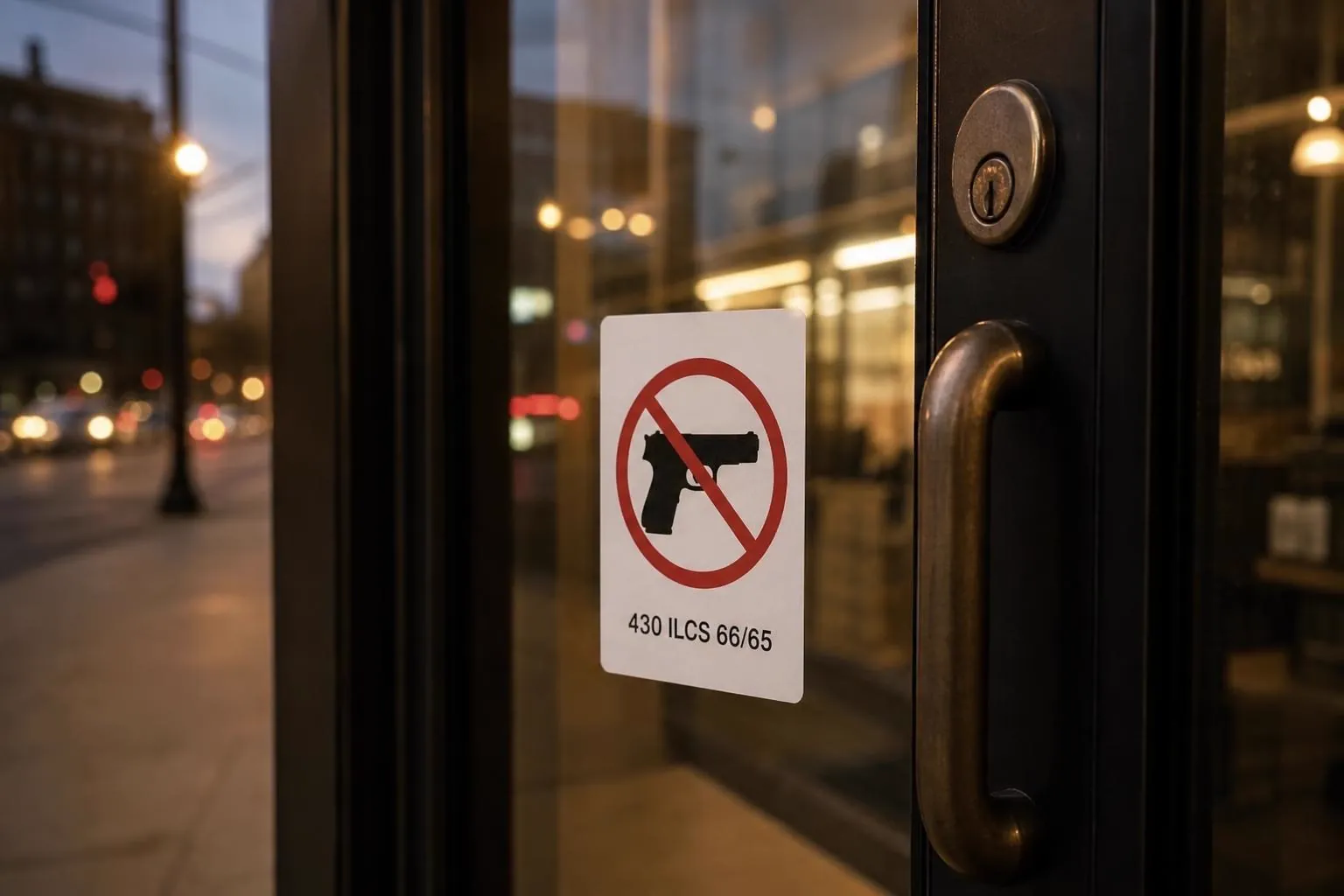
Section 65 is where the Act does its real work. A licensee may not knowingly carry into schools and their parking lots, pre-schools and child care facilities, colleges and universities, buildings controlled by executive or legislative officers, courthouses, local government buildings, adult and juvenile detention facilities, hospitals and mental health facilities, public transportation buses and trains, any establishment where more than half of gross receipts come from alcohol, public gatherings held under a permit, playgrounds and parks, athletic venues, libraries, airports, amusement parks, zoos, museums, casinos, and nuclear facilities. Any private property owner may add his own building to the list with a four-inch by six-inch sign.
Now overlay that map on an actual life in Cook County. A resident leaves an apartment, walks past a school within whose property line he may not carry, boards a train, transfers downtown, walks to a job in a building whose landlord has posted the decal, stops at a clinic, picks up a child from a daycare, and returns after dark. On that entire route, the lawful moments are the sidewalk and the car. The statute does not disarm him at the margins of his day. It disarms him through the middle of it.
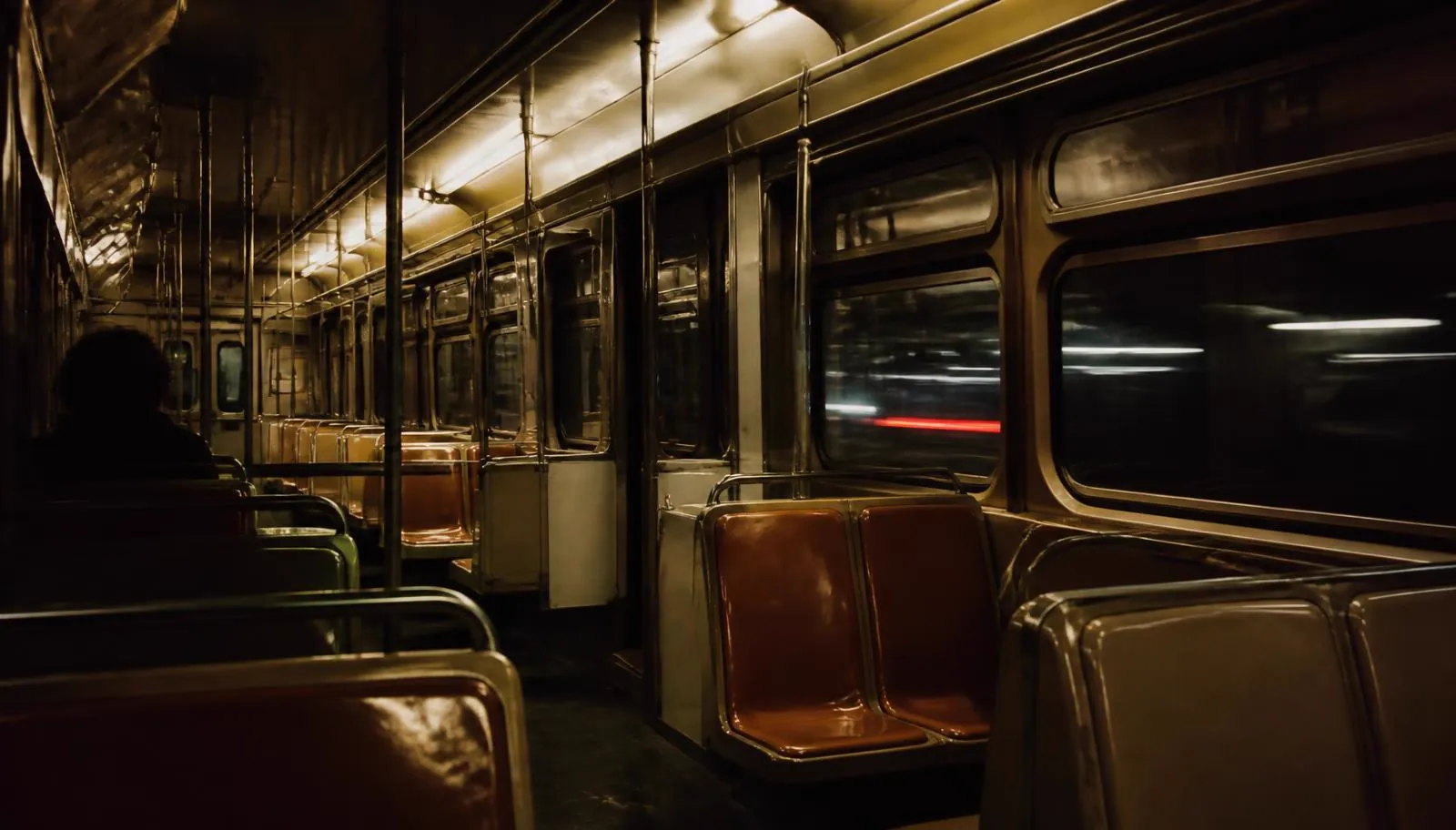
The transit prohibition is the clearest illustration. Public transportation is where a person is stationary, enclosed, unable to withdraw, frequently alone, and disproportionately likely to be a woman, an elderly rider, or a shift worker traveling at hours when the platform is empty. It is, in other words, the single environment in which a defensive tool matters most and in which the Act says a licensee may not have one. In *Schoenthal v. Raoul*, the U.S. District Court for the Northern District of Illinois held in August 2024 that the transit ban failed the Second Amendment standard set out in *New York State Rifle & Pistol Association v. Bruen*, finding no historical tradition of disarming travelers on common conveyances. On September 2, 2025, the Seventh Circuit reversed and upheld the ban, so it remains fully in force today and every licensee must obey it. The reversal settles the law; it does not answer the question. A rider on a 2 a.m. platform is no safer for having won an appeal.
The courts have trimmed this map before. In *People v. Chairez* (2018), the Illinois Supreme Court struck the thousand-foot buffer around public parks, noting that with more than 600 parks in Chicago the rule "would effectively prohibit the possession of a firearm for self-defense within a vast majority of the acreage in the city." That is a judicial finding, in plain language, that Illinois had drawn its exclusion zones so broadly they swallowed the right.
Chicago: The Numbers Cut Both Ways
Any honest argument has to begin by conceding good news. Chicago's violence has fallen hard. Preliminary Chicago Police Department figures put 2025 at 416 murders — the fewest the city has recorded since 1965 — with gun violence and overall violent crime down roughly thirty percent from 2024, itself the first year under 600 murders since 2019. That is real, it is the product of enormous work by police, prosecutors, street outreach, and trauma teams, and no one who cares about this city should minimize it.
Now hold that beside the second number. A joint WBEZ and *Chicago Sun-Times* analysis found that violent crime per passenger trip on the CTA in 2024 was more than triple the 2015 rate. Ridership fell and incidents did not fall with it, so the risk carried by each individual rider went up while the citywide totals came down. The one environment where the exposure per person has grown the fastest is the exact environment where Section 65(a)(8) guarantees that no licensee aboard is armed.
That is the contrast, and it is not an abstraction to anyone who rides the Red Line home from a second shift. Citywide averages are lived by no one. People live in a particular block, at a particular hour, in a particular car of a particular train. A thirty percent decline is cold comfort at 11:40 p.m. on an empty platform, and it is precisely there — stationary, enclosed, no avenue of withdrawal, response time measured in minutes — that the state has legislated a guaranteed disparity between the person who followed every rule and the person who followed none.
The disparagement is in the arithmetic of who bears the burden. Falling homicide numbers are attributed to enforcement, investment, and intervention aimed at the small networks driving most shootings — none of which involve the CCL holder. He contributed nothing to the problem and is asked to absorb a share of the remaining risk anyway, in the places the policy chose for him. A city can be getting safer in the aggregate and still be treating its most vetted residents as the population most in need of restraint.
There is a third number worth setting beside the first two. The Chicago Police Department's 2025 Annual Report records 419 murder incidents with 296 cleared — a **71 percent murder clearance rate, up sixteen points from 55 percent in 2024**. Robbery clearances rose from 30 to 43 percent, aggravated battery from 32 to 38 percent. That improvement is the single most encouraging line in the report, and it is exactly the kind of work that actually reduces violence: identifying, arresting, and prosecuting the people committing it. It is also incomplete. Nearly three in ten murders and well over half of robberies in 2025 ended with no one held to account, and motor vehicle theft cleared at five percent. Consequence is arriving more often than it used to, and still not often enough to be the thing a rider on an empty platform can rely on.
Who Is Actually Licensed — County by County
The Illinois State Police publish the count of currently valid FOID cards and Concealed Carry Licenses for every county in the state. The picture that emerges is not the one the debate assumes.
As of the most recent posting of that dashboard, **516,213 Illinoisans hold a valid CCL** and 2,563,492 hold a FOID card. Measured against Census Bureau population estimates for 2024, that is about **41 licensees for every 1,000 residents statewide** — roughly one in twenty-five people, licensed and vetted.
- **Cook County: 199,652 active licenses** — 38.7 percent of every CCL in Illinois, in a county holding 40.8 percent of its people. The county most often described as hostile to carry issues nearly two out of every five licenses in the state.
- **Will County: 37,621 (53.1 per 1,000)** — the highest count of any collar county and a per-capita rate well above Chicago's.
- **DuPage 30,785, Lake 21,601, Kane 17,020, McHenry 13,462.** The six-county Chicago metropolitan area accounts for roughly 62 percent of all licenses in Illinois.
- **Downstate carries at a higher rate, not a higher volume.** Outside Cook and the collar counties, the rate is **45.5 per 1,000** against Cook's 38.5. In the southeastern counties it climbs steeply: Hamilton 88.6, Edwards 86.6, Pope 84.0, Johnson 80.7, White 79.2 per 1,000 — one licensed carrier for roughly every dozen residents.
Two conclusions follow, and they cut in the same direction.
First, the burden of Section 65 falls hardest on the population that carries in the densest environment. A licensee in Hamilton County rarely encounters a posted decal, a permitted street festival, or a train. A licensee in Cook County encounters all three before lunch. The prohibited-area list is nominally statewide; in practice it is a Chicago-area statute, and roughly two hundred thousand of the people it disarms live in the one place where the exclusion zones overlap continuously.
Second, this is a very large, very well-documented, and demonstrably law-abiding population. In 2025 the ISP received 43,571 new CCL applications and denied 109 — about two-tenths of one percent. Half a million Illinoisans submitted to fingerprinting, a background review, an objection period, and sixteen hours of instruction. They are not a fringe. They are a licensed civilian body larger than the population of Kansas City, and the state's policy response to them has been to keep narrowing the ground on which their training is allowed to matter.
Who Actually Obeys the Signs
Here is the sentence the debate keeps refusing to finish: a criminal, by definition, is a person who does not obey the law.
The prohibited-area list is enforceable only against people who read signs and intend to comply. It is enforced by the licensee's own conscience — a conscience the state has already tested with a background check, a fingerprint card, an objection period, sixteen hours of instruction, and a live-fire qualification. The armed robber on the platform submitted to none of that. He was not deterred by the decal on the door, because the decal is not addressed to him. It has never been addressed to him.
The federal data on where offenders get firearms says the same thing from the other direction. The Bureau of Justice Statistics' survey of state and federal prisoners found that among those who possessed a firearm during their offense, roughly 43 percent obtained it off the street or from the underground market and another large share got it from a family member or acquaintance, while only about one in ten purchased it from a licensed retailer — and about one percent acquired it at a gun show or flea market. The supply chain the restrictions police is not the supply chain the violence uses.
A law that only the law-abiding can violate is not a public safety measure. It is a tax on obedience.
"Sensible Gun Laws" — Shooting Blanks
The phrase arrives every session, delivered with certainty and almost never with a mechanism. *Sensible* is doing a great deal of work in that sentence, and it is usually working alone.
A proposal is sensible if you can trace a plausible line from the text of the policy to the behavior of the person committing the crime. Most of what is offered cannot draw that line. It regulates cosmetic features, magazine capacity, purchase intervals, and posted signage — all of which bind the compliant purchaser and none of which touch the straw purchase, the stolen firearm, the private-market transfer in an alley, or the offender already carrying in defiance of a felony statute. When the policy fails, the failure is blamed on insufficient severity, and the next round tightens the same screw.
Meanwhile the interventions with the strongest evidence behind them — focused deterrence with the small networks driving most shootings, clearance rates for shootings and homicides, swift consequences for illegal carry by prohibited persons, violence interruption, hospital-based intervention — require patience, money, and prosecutorial follow-through. They are harder to legislate and harder to photograph. So the state legislates what is easy: another restriction on the man who filed the paperwork.
That is what shooting blanks looks like. There is noise, there is recoil, there is an audience — and nothing downrange has moved.
What Sensible Would Actually Mean
If the goal is fewer victims rather than more statutes, the honest policy is to raise the competence of the licensed and lower the number of places where their competence is legally irrelevant.
**Narrow the prohibited-area list to places with real security.** The defensible principle is simple and already understood in courthouses and airports: a government that disarms you at the door owes you a controlled entry, screening, and an armed response inside. Where the state provides none of that — an unstaffed platform, a library branch, a posted storefront on a corner where robberies cluster — the prohibition transfers risk to the disarmed and provides nothing in return. Every exclusion zone should have to answer one question: *who is protecting the people we just disarmed?*
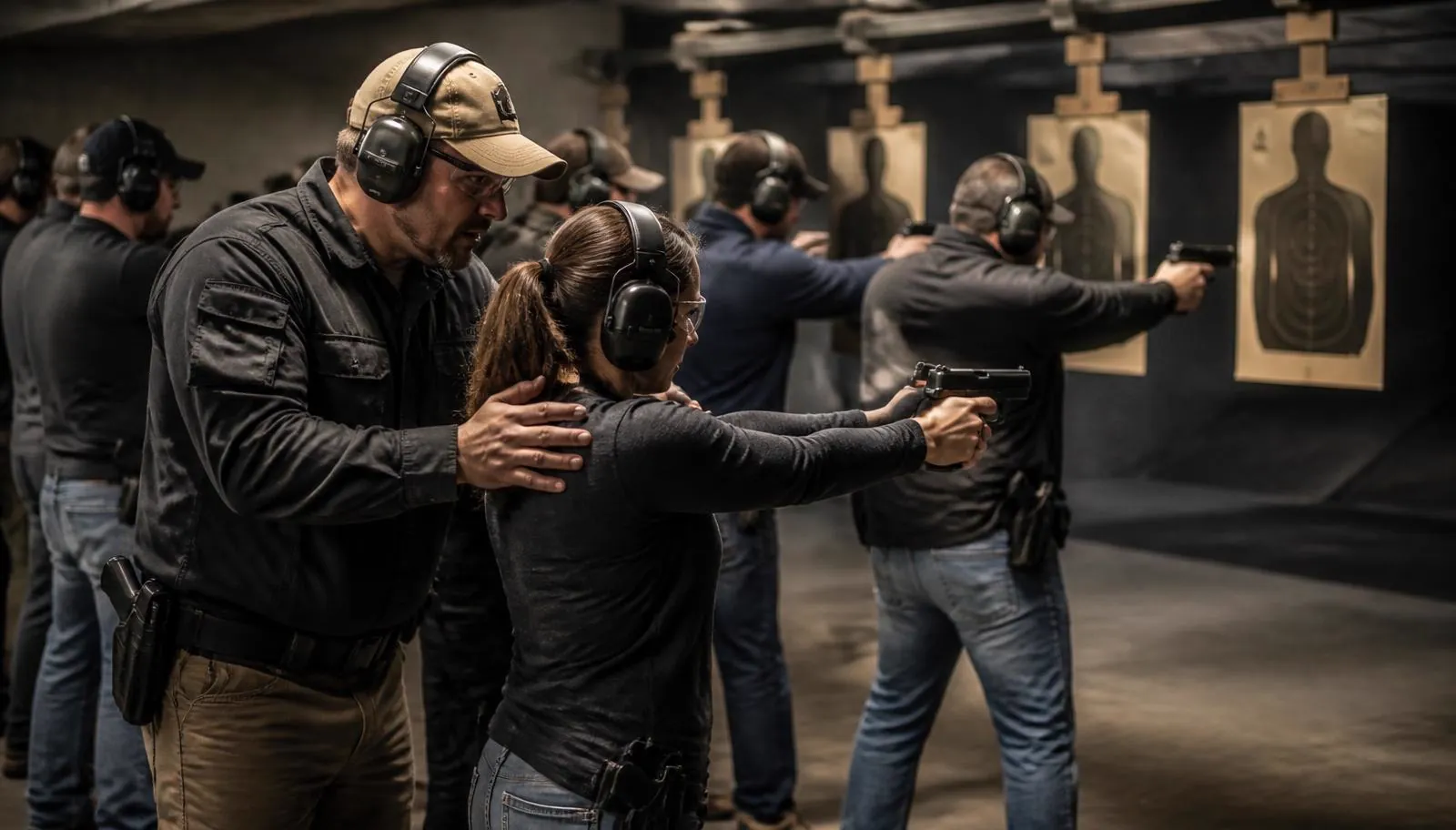
**Require real, recurring training — and mean it.** This is where we part company with much of our own community. A CCL in Illinois is valid for five years, and renewal requires three hours of instruction and **no live-fire requalification at all**. A licensee can carry for a decade or more having fired one qualification course in his life: thirty rounds, at five, seven, and ten yards, needing seventy percent hits on a B-27 silhouette. That standard establishes that a person is not dangerous. It does not establish that a person is competent.
Proficiency is perishable, and the skills that decide a defensive encounter are not the ones that course measures. A serious framework would look more like:
- A live-fire requalification at every renewal, not a classroom hour.
- A shorter renewal cycle — two or three years — for anyone who carries daily.
- Standards that include drawing from concealment, one-handed manipulation, malfunction clearance, and low-light performance.
- Decision-making under stress: use-of-force law, verbal de-escalation, disengagement, and the legal aftermath.
- Trauma response — tourniquet, wound packing, chest seal — because the licensee is far likelier to save a life with a bandage than a bullet.
Note what these proposals share. They cost the licensee something. They ask more of him, not less. That is precisely why they are credible where the other kind is not: a requirement that improves the person entrusted with the tool is regulation, while a requirement that only strips ground from him is confiscation on the installment plan.
The Disadvantage, Stated Plainly
Strip away the argument and the arithmetic remains. Illinois takes a resident who has been fingerprinted, background-checked, objected-to-and-cleared, trained for sixteen hours, and qualified on the range — and then tells that resident he may not be armed on the train, at the clinic, in the library, at the permitted street festival, on campus, or in any building whose owner prints a sign. It tells him nothing about how he will be protected in those places, because in most of them the answer is that he will not be. And it enforces all of it against exactly one category of person: the one who agreed to be governed.
That is the nullification. Not a repeal of the Second Amendment in Illinois, but a right issued with so many carve-outs that it functions only where it is least needed and disappears where it matters most.
Our Position
We train people to be the kind of citizen who should be trusted with this responsibility — and to be so far beyond the state's minimum that the minimum becomes irrelevant to them. If you carry in Illinois, know the prohibited-area list cold, obey it while it stands, and work through lawful means to change it. Then train past the qualification course, because the statute's standard was never designed to keep you alive; it was designed to keep the state's liability low.
The heart is what governs the hands. Illinois has spent a decade legislating the hands. We will keep working on the heart — and on the skill that makes a good heart effective.
References & Footnotes
Illinois Statute & Regulation
- 1.Firearm Concealed Carry Act, 430 ILCS 66/65 — Prohibited areas
- 2.430 ILCS 66/75 — Applicant firearm training (16 hours; 30-round qualification at 5, 7, and 10 yards; 70% standard)
- 3.430 ILCS 66/50 — License renewal (5-year term; 3 hours of training)
- 4.20 Ill. Adm. Code Part 1231 — Illinois State Police, Firearm Concealed Carry Act Procedures
Courts
- 5.Moore v. Madigan, 702 F.3d 933 (7th Cir. 2012) — struck Illinois' ban on carrying outside the home and set the 180-day deadline that produced the Act.
- 6.New York State Rifle & Pistol Ass'n v. Bruen, 597 U.S. 1 (2022) — text, history, and tradition standard.
- 7.Schoenthal v. Raoul, No. 3:22-cv-50326 (N.D. Ill. Aug. 30, 2024) — public transportation ban held unconstitutional as applied
- 8.Schoenthal v. Raoul, Nos. 24-2643 & 24-2644 (7th Cir. Sept. 2, 2025) — district court reversed; the public transportation carry ban upheld and currently in force
- 9.AP News (Sept. 2025) — federal appeals court upholds Illinois ban on concealed carry aboard public transit
- 10.People v. Chairez, 2018 IL 121417 — 1,000-foot public-park buffer struck; court noted Chicago's 600-plus parks would bar carry across most of the city.
Licensing & Population Data
- 11.Illinois State Police / State of Illinois public data portal — "Cards Per County" dashboard: currently valid FOID cards and Concealed Carry Licenses by county (516,213 active CCLs statewide; Cook County 199,652), accessed August 20, 2026
- 12.Illinois State Police — 2025 Gun Trafficking Information Act Legislative Report (43,571 new CCL applications received; 109 denied)
- 13.U.S. Census Bureau — Vintage 2024 county population estimates for Illinois (used to compute licenses per 1,000 residents)
- 14.Chicago Police Department — 2025 Annual Report, Index Crime Clearances (murder clearance 71% in 2025 vs. 55% in 2024)
Crime & Sourcing Data
- 15.U.S. Bureau of Justice Statistics, "Source and Use of Firearms Involved in Crimes: Survey of Prison Inmates, 2016" (NCJ 251776)
- 16.Giffords Law Center — Location Restriction Laws in Illinois
- 17.Illinois State Police — Firearms Services Bureau (FOID and CCL licensing data and requirements)
- 18.ABC7 Chicago (Jan. 1, 2026) — 2025 preliminary CPD data: 416 murders, fewest since 1965; violent crime down about 30%
- 19.ABC7 Chicago (Jan. 1, 2025) — Chicago under 600 murders in 2024 for the first time since 2019
- 20.WBEZ / Chicago Sun-Times (Sept. 6, 2024) — violent crime per CTA passenger trip more than tripled since 2015
- 21.Chicago Police Department — Annual Reports and CTA crime dashboard
Statutory citations reflect the text of the Act as published by the Illinois General Assembly at the time of writing. Litigation over Section 65 is ongoing and holdings may change on appeal. Nothing in this article is legal advice; consult a licensed Illinois attorney about your own circumstances, and comply with every prohibited-area restriction currently in force.
Ready to train with us?
Reserve your seat in an upcoming class or request a private session.
Register for Training